Mirador Portfolio Management Update for the Fourth Quarter of 2025
By Stan Clarke, January 5, 2026
Overview Of Last Quarter
Dear Friends and Clients,
We hope you have had a fantastic holiday season. It has been very busy for Stan and Joyce at Mirador. There has been plenty happening with industry requirements, and portfolio risk management related to the increased volatility that we often experience in the fall and early winter months.
Thank you to all the clients that sent additional capital to Mirador. We truly appreciate your trust in the Mirador Team and our portfolio management style and approach. Although what we do might not seem very exciting, we are all experiencing the benefits of high income and comfortable stability in our non-stressed day-to-day lives, and in our bountiful pocketbooks. Let’s leave the excitement to sports and movies! This letter is the second issue designed to focus more on the technical, data-oriented approach that has been the foundation of our portfolio management for decades.
The fourth quarter of 2025 turned out to be very volatile and challenging to manage. Our transaction volume was huge and overall, quite successful. The main sources of volatility were:
- Energy price swings created by developments with Russia / Ukraine, the U.S. / Argentina riff over oil and drugs, infrastructure developments in Canada, plus the usual OPEC supply announcements
- Precious metal supply constraints
- Emerging details regarding tariff implementations
- The cannabis legalization development in the U.S.
- The debate regarding a possible Artificial Intelligence related bubble developing
Frankly, most of the above didn’t have a significant and direct impact for the income investing style that we do at Mirador. We do have significant exposure to oil and gas, and that has given me cause to be concerned, but the income from these holdings is paying us to be patient. But what happens in the above market sectors that are mostly outside of the income generating universe does affect the overall market and hence makes our work challenging. One reason behind this is the degree of index investing these days. Many of our income investments are part of the indexes so they are dragged into the volatility created by index trading.
Perhaps of most relevance is how many of the top performing index sectors of 2025, such as technology, precious metals and cannabis, pay very little, if any, dividends. This has made the relative results comparisons of income programs like Mirador’s to the stock indexes challenging. No matter how well a stock or sector is performing and propelling the index higher, if it doesn’t have above average dividend factors, we can not hold it.
Instead, to a degree, we participate in these outperforming sectors and stocks using the Mirador Premium Plus covered call writing program. Our work in Premium Plus greatly helped us to outperform the typical income portfolios that only use dividend stocks and fixed income. The added cash flow from Premium Plus was tremendous. But the strike price of the call options limited the capital gains to approximately 3% per the 2 or 3 month option duration. This equates to 12% to 18% annualized gains. So, the annualized numbers are good for Premium Plus, and they really helped make up for the lower income security performance, but the Premium Plus numbers are not as great as say the technology, gold or cannabis index numbers due to the gains being limited by the strike prices.
With regards to the bubble talk around artificial intelligence (AI), this is not the same as the late 1990s. In the late 90s many technologies and businesses were completely new and unknown. The internet itself was new. Pundits even called it the ‘new economy’. After the year 2000 it became clear that many of the new technology participants were either not viable or had much less economic potential than originally thought.
AI is not a completely new and unknown field of technology. Yes, new products, services, programs and technologies are evolving from it, but many of the AI concepts and methods have been around for decades. And much of the AI developments are simply a result of the information growth of the internet and the ability to harness that information better because of improved storage and processing technologies. Given this, the bubble-potential is not as great as some are thinking, and certainly not like the year 2000 technology bubble burst. Remember that the market always over-shoots due to the greed factor, and then reality checks-in and brings things back to earth. And this is already happening in the AI world. And that is not a bubble. The valuations are not like the 100 plus P/E ratios of 1999.
The most exciting news we have to report is that for a second year in a row, the Canadian Mirador Income and Stability Fund (MISF) has paid a bonus distribution. The 2025 bonus distribution is 2.25%. This is in addition to the 7.5% regular distribution established last January and maintained through all of 2025. So the total distribution income for 2025 is 9.75%.
For comparison purposes, looking at non-registered accounts, because the fund’s regular distribution is very tax efficient and the bonus distribution is all capital gains, you would have to get between 12% and 13% from a GIC at the bank in order to make the same after tax income as the MISF. The MISF is now 6 years young, and the distribution has been equal to or greater than 7% in all but one year.
The fund also realized capital gains, improving the results and bringing the 2025 total return to 15.51%.
We are also pleased to announce that we are establishing the 2026 distribution rate at 7.5% again. Because the unit value has improved this is actually a 5.6 % increase in distribution over 2025. This distribution increase is 2.6 times the current Canadian inflation rate of 2.2%.
What we are doing here at Mirador with the MISF is not being done by anyone else we know of, and we have done enough research to be confident in this statement. It is unique and frankly brilliant. If you have capital elsewhere, please consider adding it to your Mirador portfolio.
Your custodian, RBC IS, is totally safe and secure, and we are managing your capital for stable capital values. If you have friends or family looking for people that are caring and exceptionally competent, and are providing decent results without compromising investor comfort, please recommend Mirador. Obtain their permission for us to contact them. They will thank you many times over the next many years.
Now for the real data focus and commentary,,,,,,
Portfolio Stability Data
Greatest Drawdowns as of Wednesday December 31, 2025
The most important measure for risk management is drawdown. Drawdown is the percentage measure of the decline from the most recent high for a portfolio, index, or security. By reducing drawdown, we make life more comfortable, so our clients sleep better, and we ensure that we have more capital intact for when things improve, which allows us to recover more quickly when the good times return. The greatest drawdowns for 2025 remain the same as the last report because they did not occur in the 4th quarter. We have included numbers for the drawdown in value for the quarter, providing more transparency regarding the quarter’s results:
| Q4 % | 2025 % | |
|---|---|---|
| XBB Canadian Bond Universe ETF | -17.38 | -18.23 |
| XIU Canadian TSX 60 ETF | -2.29 | -9.72 |
| SPY U.S. S & P 500 Index ETF | -3.38 | -17.13 |
| Benchmark | -1.81 | -9.98 |
| Canadian Mirador Income & Stability | -2.09 | -6.48 |
Q4 2025 Number of High-Water Marks (HWMs) as of Wednesday December 31, 2025
There is little benefit to less drawdown if we are not also providing new high-water marks when the markets are positive. A high-water mark is an all-time new high for a portfolio, index or security. HWMs don’t completely indicate performance, but they do measure positivity and consistency, which is helpful when combined with the rolling return numbers that follow later in this letter.
| Q4 | 2025 | |
|---|---|---|
| XBB Canadian Bond Universe ETF | 0 | 0 |
| XIU Canadian TSX 60 ETF | 5 | 22 |
| SPY U.S. S & P 500 Index ETF | 5 | 18 |
| Benchmark | 5 | 17 |
| Canadian Mirador Income & Stability | 2 | 21 |
Standard Deviation as of Wednesday December 31, 2025
Statistically, standard deviation is the square root of the variance. Variance is the spread of a data set from an average and uses the squared value of the spread. Standard deviation is one of the most suitable and common measures of volatility or consistency in data sets such as the weekly returns for a portfolio or index. The lower the standard deviation, the lower the volatility, and the more consistent and stable the results are. The following table shows the weekly standard deviation of Mirador’s benchmark, the benchmark components, and the Canadian Mirador Income and Stability Fund:
| Q4 2025 | Since Inception | |
|---|---|---|
| XBB Canadian Bond Universe ETF | .52 | .95 |
| XIU Canadian TSX 60 ETF | 1.42 | 2.23 |
| SPY U.S. S & P 500 Index ETF | 1.60 | 2.71 |
| Benchmark | .95 | 1.57 |
| Canadian Mirador Income & Stability | .77 | 1.47 |
Portfolio Income and Results Data
Current Income Picture as of Wednesday December 31, 2025
Stability in your portfolio value is a key goal of our work so that you remain comfortable with your investments and so that we preserve your capital as well as possible. But, high income is the key result for our investors who depend on the cash flow from their capital in order to live their best lives possible. Income is best expressed in annual percentage terms. The following summarizes the currently indicated annual percent yields on some comparative income alternatives along with the Canadian Mirador Income and Stability Fund. Again, remember that of all these alternatives, the MISF is also the most tax efficient so in non-registered accounts it provides the best after-tax cash in your pockets.
| Current Annual % Income | |
|---|---|
| XEI iShares High Dividend Index | 4.23 |
| CDZ Dividend Aristocrat Index | 3.37 |
| XBB iShares Cdn Universe Bond Index | 3.39 |
| GICs non-redeemable 1 to 5 years | 2.6 to 3.35 |
| Canadian Mirador Income & Stability | 7.5 |
Rolling Return Data as of Wednesday December 31, 2025
As you might recall, just like draw-down is the most important risk measure, rolling returns are much better for examining results (versus calendar defined periods). Rolling returns are simply the returns for a time period specified prior to the stated “as of date”.
| 4-week | 12-Week | 26-Week | 52-Week | |
|---|---|---|---|---|
| XBB Canadian Bond Universe ETF | -1.44 | -1.09 | -.25 | -1.83 |
| XIU Canadian TSX 60 ETF | 1.24 | 3.29 | 17.98 | 21.19 |
| SPY U.S. S & P 500 Index ETF | -2.15 | 1.89 | 14.75 | 13.17 |
| Benchmark | -.27 | 1.12 | 9.72 | 9.59 |
| Canadian Mirador Income & Stability | 1.59 | .99 | 8.58 | 13.71 |
Data Notes: The benchmark is 40% XBB (Canadian Bonds), 30% XIU (Canadian Stocks), 30% SPY (U.S. Stocks)
Summary Comments on the Above Stability, Income, and Overall Results Data
- The MISF drawdown for the year of 2025 has been the lowest in all comparisons, creating the stability in capital values we all want and focus on
- The quarterly drawdown of the MISF was less than all comparisons except the benchmark, and this was mostly due to the volatility of our oil and gas positions
- Only the Canadian stock index had a higher number of HWMs than the MISF annually, due to the large allocation of gold and precious metals in the index
- The MISF volatility (standard deviation) is significantly lower than all comparisons except for bonds. But the volatility of bonds is low because the returns have been around zero or slightly negative (see the XBB rolling return numbers). Not many people would be happy with achieving low volatility by making no money!
- Mirador’s income is substantially higher than all the comparisons
- Our income is very tax efficient (approximately 12-13% interest equivalent)
- We exceeded our 7.5% distribution for 2025, we made a bonus distribution of 2.5%, and we have raised the distribution income for 2026
- Because the unit value has increased, the 2026 distribution projection represents a 5.6% increase in annual cashflow which is providing you with substantial inflation protection and better purchasing power
- Our shorter-term rolling returns (4 week) have done better than all comparisons.
- Our medium-term rolling returns suffered due to the energy volatility last fall
- The longer-term returns continue to surpass the benchmark
Current Subsystem Allocations for the Mirador Income and Stability programs:
| Percent Allocation | |
|---|---|
| 1 - Equity Income | 50 (55% dividend growth, 45% high yield) |
| 2 – Premium Plus Covered Call Writing | 15 |
| 3 - Fixed Income Preferred Shares | 34 |
| 4 – Market Exposure | 0 |
| 5 – Cash or Short Term | 1 |
| Total | 100 |
Sector Allocations for the Mirador Income and Stability programs
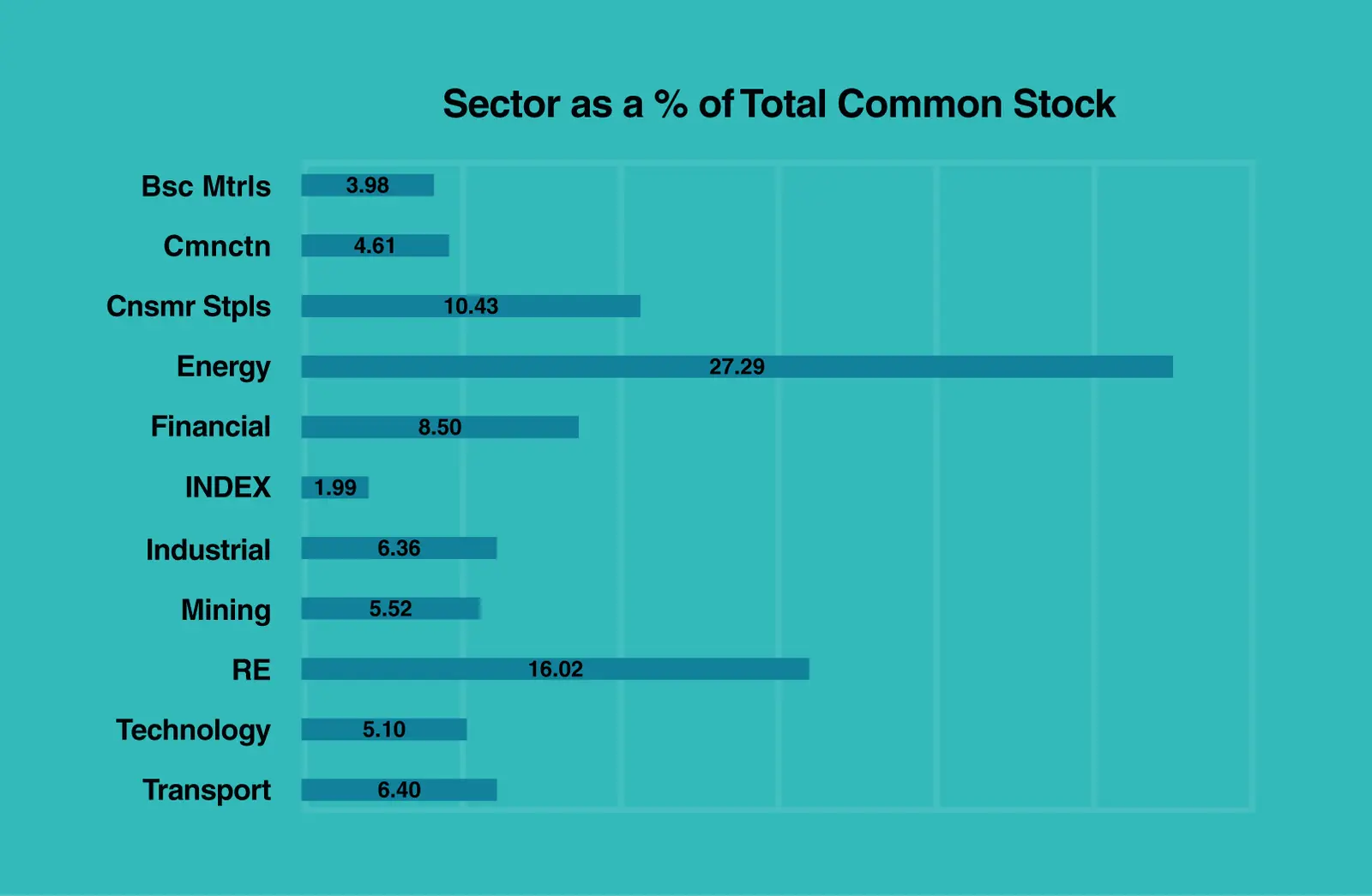
Please note that the above energy sector allocation includes nuclear, alternative / green energy, energy infrastructure, pipelines, as well as oil and gas companies.
Subsystem and Sector Allocation Comments
The Magic of “Auto Rebalancing” Although a comparison to last quarter’s numbers makes it seem as though little has changed between the relative quarter-end allocations, a lot happened during the quarter because the different subsystems grew at different enough rates and that led us to perform considerable rebalancing. This is one of the beauties of our process for our subsystem and Market Exposure allocation process – to keep all components in balance, we end up taking the profits from outperforming areas and allocating the proceeds to lagging areas. This has a good impact on diversification, portfolio stability, and realized gains for enhanced distribution potential. Last quarter we:
- Reduced Fixed Income Preferreds to maintain / slightly lower its percent allocation
- Although the Premium Plus allocation stayed the same, we took profits from our precious and base metals and oil & gas positions, and allocated the proceeds to technology and healthcare, but healthcare is looking a little ill lately and will likely be reduced soon
Based on relative strength and relative income analysis, the main changes to sector exposure were as follows:
- Basic Materials Decrease – they have seen a good run to the point where their future potential is diminished, and their yields are less attractive
- Consumer Staples Increase – they have seen improved relative strength. Staples are seen as defensive, so this is likely a sign that there are concerns about the continuity of the bull market and funds are being allocated to more stable and defensive sectors
- Financials Decrease – it was a banner year for Canadian banks, driving the yields to very low levels. We can not hold securities with yields this low and still maintain our high level of income distribution
- Mining Decrease – again the price increase has resulted in less future potential and unacceptably low yields
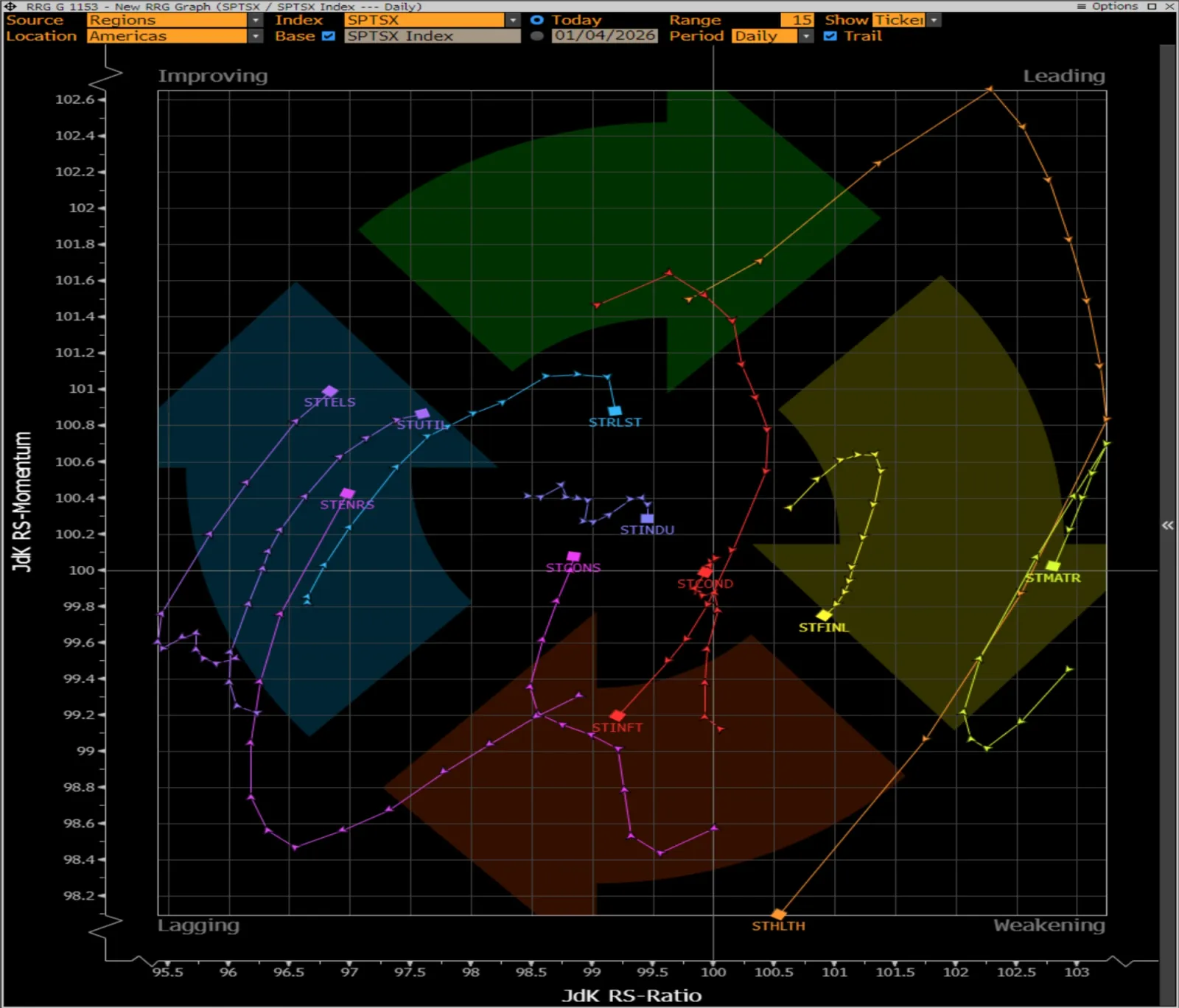
By plotting sector momentum against sector strength relative to the overall market we are able to visualize important shifts in sector changes and rotations with greater clarity:
Seasonality, Market Psychology and Sentiment Factors
Those of you that have been with Mirador for decades will remember how seasonality can be a factor. The Bloomberg Professional Terminal subscription allows us to monitor seasonality, and I have used their Graphical User Interface to do this for over 16 years. Seasonality has less of an impact than it did 16 years ago, but the historic data still indicates that it is a factor to keep tabs on. The seasonal effect took hold in late November, and we quickly became fully invested in the sectors contributing the most to the “Santa Clause” rally. Post Christmas the strength has been maintained as has our positive market stance / allocation.
As we said last quarter, we genuinely add the most value and really earn our keep when the market party is over, the bull gets mauled by the bear, and Mirador gets to work its magic keeping your portfolio more stable by reducing your drawdown. The sentiment indicators show little sign of this happening and the AI neural networks that guide our market exposure confirm that we are fully invested at this time. The only thing that could be more positive is if we could see a broader depth of inclusion in the bull trend – the concentration of market capitalization in large-capitalization technology is still a concern to us.
Recent Theme(s) – Economy in a Pivot and Rebalancing
The main theme to draw attention to is the inflation versus employment theme and how it is changing the yield curve. The central banks of the world have made a pivot to a relaxation of rates now that inflation is reduced and employment is deteriorating slightly. This has resulted in a good move further towards a fully positively sloped yield curve:
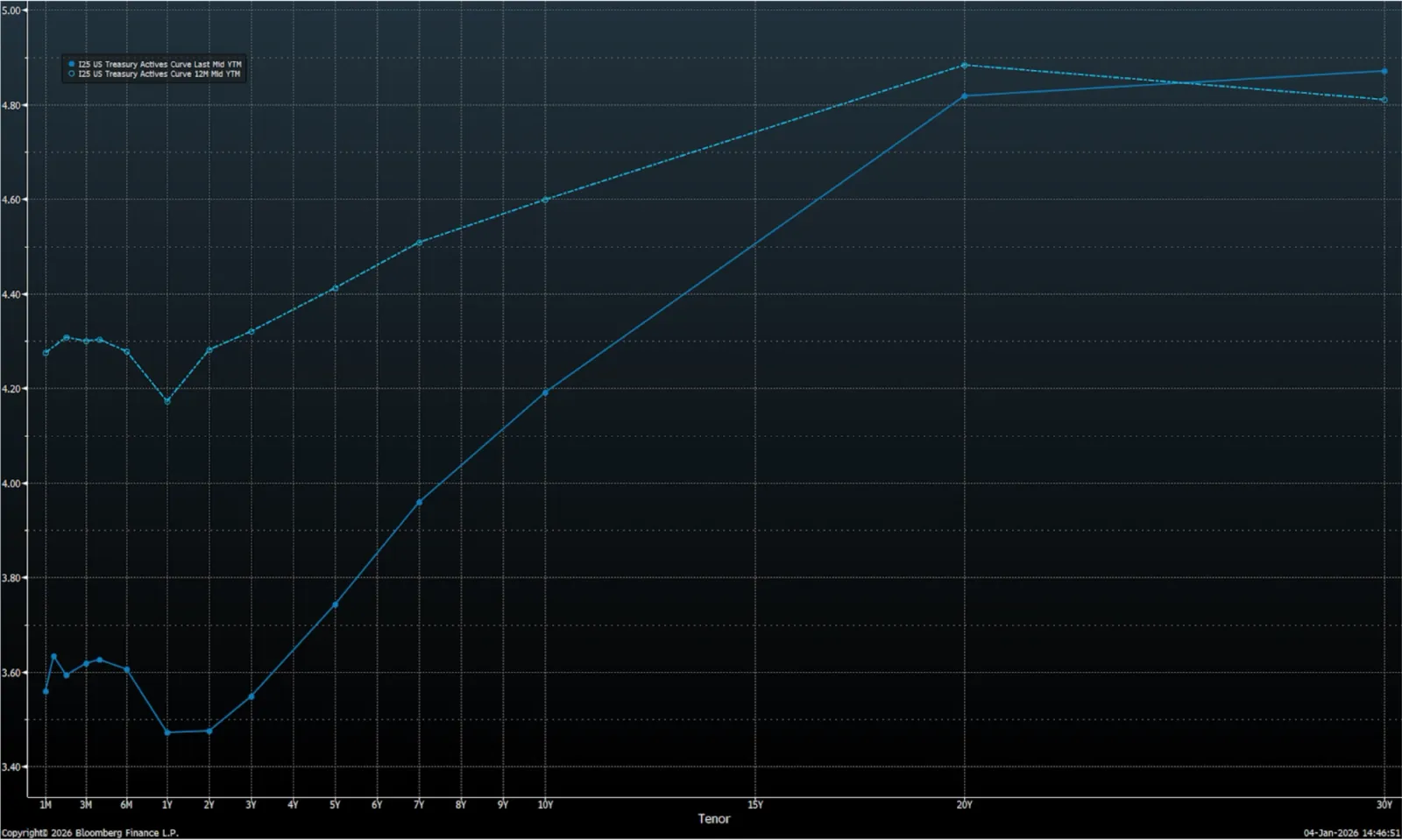
(bottom line is now versus top line from a year ago)
Other Data We Watch Closely
Yield Curve
See above Recent Theme(s)
Currencies
The CAD had major strength last quarter, but the momentum has reversed over the last few days. The strength was likely due to a perception that Canadian rate declines may slow down and also that, due to the recent U.S. rate reductions, our rates are now relatively more attractive. The reason for the recent loss of momentum in the CAD is currently unexplainable.
Earnings
The corporate revenue and earnings on both sides of the border were surprisingly good in Q3 from both a growth and surprise perspective. The earnings releases for Q4 will start soon and monitoring them closely will be a major focus for us over the next 6 weeks or so. The recent stock price rally has priced in expectations for overall positive earnings, so any disappointments will result in great punishment of the stock price. Immediately we will be checking analysts’ revisions as a way to find clues prior to earnings releases that might create pain in the portfolio and lead us to trim positions sooner.
In the Wealth Planning Department…
The 2026 TFSA contribution limit is $7,000 again this year. Joyce will be contacting everyone regarding this year’s contribution. In the meantime, feel free to pop her an email if you would like her to proceed with your 2026 contribution.
The deadline to make RRSP contributions that can be deducted in your 2025 tax return is March 2, 2026. Just a friendly reminder, if you have not yet made your RRSP contribution, please reach out to Joyce to make arrangements.
Lastly, Joyce will be working diligently on getting all of your 2025 tax information ready. She anticipates being able to send it out to everyone no later than the end of February 2026. If you would like her to send it directly to your tax advisor, she would be happy to do so.
On the Personal Side…
Joyce is working on your Q4 portfolio reports, and they will be emailed to you soon. These annual versions include the annualized result reports, so they do take extra time to produce.
Joyce and the girls spent most of the holiday season in Kananaskis enjoying the strength and beauty of the mountains and putting in some good snowshoe and cross-country ski time.
Out here in the hills southwest of Longview we have experienced record high volatility in the weather that has made animal and property care challenging. The weather has not delivered extremes – yet – but the changes in wind and temperature have been stunning.
Jessica is planning her first travel adventure. Later in January she heads to the Scandinavian countries for 7 weeks! After that she will be looking for work as a server at a resort.
Emily is graduating in June so she continues to spend a huge number of hours making sure her marks will get her into wherever she decides to go after high school. Emily continues her time in Rugby as her team prepares for a trip to Australia in February.
I continue to keep my weight low and fitness high. With the long nights and cold outdoors, I have shifted more time to my musical interests, and I am pleased with the progress I am feeling with my drumming. If you know anyone at the professional musician level that needs a good drummer and a nice band member, please feel free to hand out my name and number!
Economies of scale are very important now because we have not raised our fees in 14 years, yet all our custodial, administrative, trading and living costs have increased greatly. Please recommend us to friends and family. Please consider consolidating more investment capital with us. Remember the website:
That’s it for Q4 2025. As always, phone or reply to this email to just say hello, or if you have any questions, comments or ideas. In the month of January, we will be contacting you to arrange a personal delivery of our expression of gratitude, best wishes for 2026 and beyond, and a quick chit-chat if time allows.
Sincerely,
Stan 403-608-4664
Joyce 403-978-6798